Monday, June 17, 2013

Dr. E. Margaret Fulton's Lasting Legacy


Another Convocation season has come and gone – a bittersweet time of year for us at the Mount.

Everything we do is for our students and while we proudly celebrate as they cross the stage, we must also say goodbye as they set out to make their own mark on the world.  I invite our 620 new Mount graduates to join me in celebrating the mentors, teachers, and peers who have helped prepare them for what’s to come.

Last month, we had the privilege of sharing our Spring Convocation with a number of outstanding women. Poet Lorna Crozier, sociologist Arlie Hochschild, and soprano Suzie LeBlanc (pictured left) received honorary doctorate degrees and offered graduates compelling insights on compassion, ambition, risk-taking and strength. Dr. LeBlanc, reflecting on the Mount’s founding by the Sisters of Charity, noted that “finding your strength, finding ways to make something happen that you really believe in, is the way this university was begun.”

I hope our graduates take these words to heart as they consider not only how the Mount came to be, but how it has remained true to the Sisters’ original intent over the past 140 years. For an example of how our history has been shaped by strength, creativity, and belief, we need look no further than former Mount President E. Margaret Fulton.

While she wasn’t able to join us in person, I am delighted that Dr. Fulton was recognized at our Spring Convocation in her new role as President Emerita, in tribute to her outstanding contributions as the leader of this institution from 1978 to 1986, and as a trusted friend ever since.

Dr. Fulton broke new ground from day one at the Mount, serving as our first President who was not a Sister of a religious order, as well as the only woman President of a Canadian university at that time. In a 1999 interview she recalled how shared priorities with the institution turned an unconventional pairing into the perfect fit:

“The goals and the statement fitted perfectly where I was at that time: my commitment to the changes in the women’s movement, and the development of a feminist perspective, and a desire to provide more opportunities for women to get an advanced education.”

It was her passion for women’s education that drove Dr. Fulton to usher in an era of great innovation at our university. While she’s quick to credit her success to others, it was under her leadership that the Mount made education more accessible by becoming the first university in Atlantic Canada to offer televised courses. Further, it was through her work with our dear Ruth Goldbloom that the Mount’s first major capital campaign raised $3.5 million to fund the Rosaria Student Centre, the creation of the first Chair of Women’s Studies in Canada, and the first Co-operative Education program in the Maritimes.

And just this year, it was a gift from Dr. Fulton that pushed Project TWENTY12 past the $12 million mark, proving that even at age 90, she hasn’t quite finished shaping the future of the Mount for generations of students yet to come.

In my conversations with Dr. Fulton, what always strikes me is the wonderful curiosity and excitement she continues to feel about everything to do with the Mount. She believes in us, she still expects a lot from us, and it is our ongoing privilege to continue building upon her remarkable legacy.

Congratulations, Margaret, and thank you.

Monday, April 29, 2013


Small and Successful

In conversations about the Mount, people often mention our size. That’s quite natural when you consider, in a world of mega-universities, our overall enrolment of 4,000 students and our average class size of 24.

Size alone isn’t what’s important, however, but rather the advantages we can derive from being small. Our typical class size means our professors really do know their students on a first-name basis. It’s our size that allows us to form close personal and professional connections with one another, creating a highly engaged learning community—a key component in the success of our students, staff, and faculty.

Take Dr. Peter Mombourquette, for example, who is one of many Mount faculty members who extend the student experience beyond the classroom.  Peter is the Chair of our Department of Business and Tourism, and he’s a passionate champion for social entrepreneurship. Over the past two years, he has enriched the learning experience of students with extracurricular opportunities by showcasing how to solve complex problems with a balance of empathy and innovation. Starting small with food drives and blanket collections, his initiative quickly evolved into an annual two-day conference, Social Entrepreneurship for a Day (SE4D), where students collaborate with mentors to find creative solutions that address critical social needs.

SE4D developed organically, but it was far from accidental. The Mount’s environment of close-knit relationships, rich learning experiences, strong mentorship, and commitment to service saw one person’s passion become a signature feature of our student experience.  And the 150 participants in this year’s SE4D are proof that our students eagerly seek out these opportunities to contribute to the broader community.

My colleague Dr. Robert Campbell, President of Mount Allison University and current Chair of the Association of Atlantic Universities, recently noted the importance of universities to our region. He wrote in The Globe and Mail that universities in Atlantic Canada are key economic drivers, stimulating growth and creating thousands of jobs.  The primary role of universities, of course, is to stay true to our core mission—the education of our students. But education goes hand in hand with social and economic prosperity; the two are not mutually exclusive. We need to ensure that our students graduate with the knowledge and skills they need to succeed fully as human beings, and in turn their individual contributions after graduation will showcase the value of our time together. Our small size is a great asset in this undertaking.

At the Mount, our commitment to students is interwoven with the value we place on strong communities. We make sure that each of our students feels valued and engaged, and that each has the opportunity to experience a sense of belonging. In return, our students graduate ready to shape the world around them. Far from just a reflection of our size, I consider this outcome to be the hallmark of a Mount education.

Wednesday, March 27, 2013

Creating Momentum in Aboriginal Education


Consider this: more than one-third of Aboriginal people of high school age or older have not completed high school, and only eight per cent of Canadian Aboriginal people between the ages of 25 and 64 have a university degree.

It’s easy to see why Aboriginal education should be a policy priority for all levels of government in Canada. Education, particularly at the college or university level, is critical to helping all of us achieve our goals, support our families, and compete in a quickly changing job market. Historically, few First Nations students have had the tools or support to succeed in post-secondary education. Fortunately, in the past few years, there are indications that this tide is shifting.

Recognizing the challenge and the importance of providing support and access to education for Aboriginal Canadians, the Association of Universities and Colleges of Canada (AUCC) has made Aboriginal education one of its priority policy items and has been lobbying the federal government to increase funding for Aboriginal students. The AUCC has also launched a number of dynamic online tools to create awareness and understanding of the success many young First Nations students have achieved at the university level. Among these tools is a summary of opportunities in education across Canada for Aboriginal students. AUCC has also produced a compilation of resources for Aboriginal students, including a list of bursaries, indigenous services, transition programs, and elder visits across the country.

Jenna Marr, a first-year Mi’kmaq student from Indian Brook, is featured prominently as a success story in the AUCC database. Jenna, one of the Mount’s student ambassadors, is currently studying in our Public Relations program, and has helped our recruitment team reach out to prospective students through campus tours, special on-campus events, and school visits. We’re proud of Jenna’s contributions and her work as a role model for other Mi’kmaq youth.

At the Mount, we’ve introduced a number of initiatives to better support and encourage Mi’kmaq and other Aboriginal students. Our Aboriginal Advisory Committee has been instrumental in giving insights to the university’s leadership team on how we can do a better job of building a community where Aboriginal students are able to achieve their goals. We also recently welcomed Art Stevens as the Mount’s new Coordinator of Aboriginal Services to develop programming and resources to support our First Nations students.

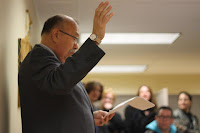
Most recently, on February 28, I was delighted to join staff, students, and special guests from the community for the opening of the Mount’s Aboriginal Student Centre. The Centre was established as a community hub where students can meet, chat, and have access to a resident counselor. Dr. Don Julien, Executive Director of the Confederacy of Mainland Mi’kmaq and member of our Aboriginal Advisory Committee, led us in prayer as part of the day’s ceremonies. We’re grateful for his leadership and for the support, wisdom and guidance of all members of our Advisory Committee.

Securing access to education affects all of us, whether at the campus, community, or national level. It’s vital—to our communities, our country, but most importantly, to young Aboriginal students from across the country—to ensure we are providing the tools for Aboriginal students to realize their dreams.

Until next time,

Ramona